
Travel Batteries – MAX & SLIM Travel Battery GuideUpdated a month ago
Foil Drive MAX and SLIM Travel Batteries are designed to make travelling with your Foil Drive easier by separating into smaller battery modules for airline travel.
The individual modules can be connected together once you arrive at your destination and must be used as a complete battery set.
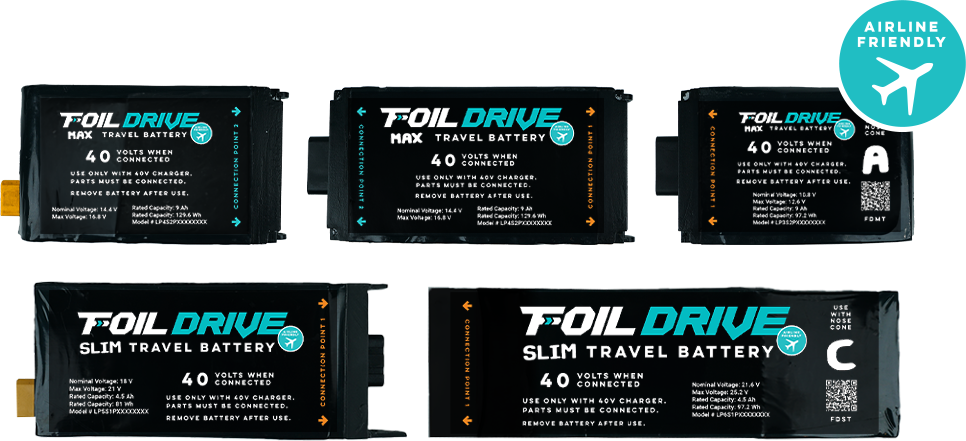
MAX Travel Battery
The MAX Travel Battery separates into three battery modules for approved airline travel:
- 2 × 129.6 Wh modules
- 1 × 97.2 Wh module
- 324 Wh total capacity when connected
The MAX Travel Battery uses the larger A Nose Cone and has a capacity between the existing MAX Sport and MAX Power Batteries.
Purchase the MAX Travel Battery
SLIM Travel Battery
The SLIM Travel Battery separates into three battery modules for approved airline travel:
- 2 × 81 Wh modules
- 1 × 97.2 Wh module
- 178.2 Wh total capacity when connected
The SLIM Travel Battery uses the larger C Nose Cone and has a capacity between the existing SLIM Performance and SLIM Endurance Batteries.
Purchase the SLIM Travel Battery
How Do Travel Batteries Work?
Each Travel Battery separates into smaller battery modules for airline travel.
Once you arrive at your destination, the modules can be connected together and installed as a complete battery.
The battery modules must always be kept together as their original set.
Travel Batteries must be charged using the existing 40V charger.
Important: The SLIM Travel Battery must NOT be used with a Fast Charger.
Airline Travel Restrictions
Airline regulations for lithium-ion batteries vary between airlines and countries. The following information provides general guidance only.
Batteries Under 100 Wh
Batteries under 100 Wh can generally be carried in carry-on baggage, subject to the airline's requirements.
Batteries Between 100–160 Wh
Batteries between 100–160 Wh can typically be carried in carry-on baggage, with many airlines limiting the number of batteries and requiring prior approval.
Batteries Over 160 Wh
Batteries over 160 Wh are generally not permitted on passenger aircraft and may need to be transported as cargo.
Always confirm the requirements directly with your airline before travelling.
All Travel Battery modules must be:
- Carried in carry-on baggage, not checked luggage.
- Protected against physical damage.
- Protected against short circuits.
- Stored with the terminals covered.
How Many Travel Batteries Can I Carry?
The number of Travel Battery sets you can carry depends on the airline's specific requirements and whether pre-approval is required.
SLIM Travel Battery
The SLIM Travel Battery modules are all under 100 Wh.
With airline pre-approval where required, customers can generally carry multiple SLIM Travel Battery sets, subject to the airline's individual policies.
MAX Travel Battery
The MAX Travel Battery contains:
- 1 × module under 100 Wh
- 2 × modules between 100–160 Wh
Because the larger modules fall within the 100–160 Wh category, the applicable airline restrictions generally mean 1 MAX Travel Battery set per passenger.
Travelling With Both MAX and SLIM
Where permitted by the airline, you may generally travel with:
- 1 × MAX Travel Battery set
- Multiple SLIM Travel Battery sets
Important: Some airlines allow additional batteries or have different requirements. Always contact your airline before travelling.
Travelling With Your Foil Drive Batteries
Contact Your Airline Before Travel
Customers must contact their airline before travelling with Travel Batteries.
If your itinerary includes multiple airlines or connecting flights, check the requirements with each airline.
Code-share flights may involve different airlines, and each airline may have different battery restrictions or approval requirements.
Travel Documentation
Your Travel Battery case is supplied with documentation to assist with airline travel, including:
- Official Safety Data Sheet (SDS) documentation.
- Official Foil Drive battery specification documentation.
- Relevant regulatory information to help demonstrate the battery specifications.
Keep this documentation with your batteries while travelling.
Battery Storage During Travel
Airlines may specify how lithium-ion batteries must be stored and may require a particular State of Charge.
At a minimum:
- Keep the battery modules separated.
- Protect the battery terminals from short circuits.
- Keep the terminals covered.
- Follow any additional storage requirements provided by your airline.
Be Prepared at Security
Airline and airport security staff may ask questions about your batteries.
We recommend travelling with your battery documentation and being familiar with:
- The Wh rating of each battery module.
- The total number of modules you are carrying.
- The airline's battery requirements.
- The relevant documentation supplied with your Travel Battery.
Being prepared can make the security process much easier.
Travel Battery FAQ
Can I use the modules as individual batteries?
No.
The individual Travel Battery modules are not designed to be used separately. The modules must be connected together and used as a complete battery set.
Can I order individual modules?
No.
Travel Batteries are supplied and must be ordered as complete sets.
Individual replacement modules are not available for separate purchase.
Can I mix and match modules between Travel Battery sets?
No.
Modules must remain with their original battery set and must not be mixed or matched between sets.
Each battery set has a white identification dot. We recommend labelling each complete set so the modules can be easily identified as belonging together.
For example, all three MAX modules from the same set should have the same identifying label.
This is important because the battery cells within each module age and degrade through use. Connecting modules with significantly different cycle histories can result in the cells having different levels of degradation.
Can Travel Batteries be used for e-foiling or Constant Power?
No.
Travel Batteries are designed for use in Assist mode only.
The connectors are not designed to handle the continuous load associated with Constant Power operation.
Do not use Travel Batteries in Constant Power mode.
Important Travel Disclaimer
Airline and dangerous-goods requirements can change and may vary between airlines, countries and routes.
The information in this article is intended as a general guide based on current 2026 IATA and Australian CASA guidance. It does not guarantee that an airline will accept your batteries.
It is your responsibility to contact your airline before travel, obtain any required approval and comply with the airline's specific requirements.
For the most current general guidance, refer to IATA – Safe Travel with Lithium Batteries and Australian CASA – Lithium Batteries.
If your airline's requirements differ from the information in this article, always follow the airline's requirements.